In a world shifting faster than ever, the U.S. dollar’s long-standing reign as the world’s reserve currency is being challenged at a speed that feels almost unprecedented.
Once the undisputed king of global trade and finance, the dollar now faces a wave of de-dollarization that is reshaping the financial landscape at a breathtaking pace — reminiscent of the early days of the Great Financial Crisis when Quantitative Easing (QE) first took hold.
A Brief History: How the Dollar Became King
The dollar’s dominance can be traced back to the aftermath of World War II, when the Bretton Woods Agreement crowned it the world’s reserve currency. Its strength was bolstered further after President Richard Nixon abandoned the gold standard in 1971, anchoring the dollar purely on the “full faith and credit” of the U.S. government.
For decades, the dollar’s supremacy was not seriously questioned. Global oil transactions (“petrodollars”), international trade settlements, and central bank reserves all revolved around the greenback. Between 1999 and 2019, the U.S. dollar accounted for over 74% of Asia’s trade and 96% in the Americas, according to the Federal Reserve.
Yet today, cracks are forming.
The Rise of De-dollarization
The seeds of change were planted during the 2022 sanctions against Russia, when the U.S. demonstrated its ability to freeze the dollar reserves of sovereign nations. For countries like China, India, Brazil, and Russia, this marked a turning point. The realization was stark: reliance on the U.S. dollar carried political risks.
Since then, the movement to de-dollarize has accelerated. BRICS nations have aggressively expanded their bloc, adding members like Saudi Arabia, Egypt, and Argentina. Trade between China and Russia now occurs overwhelmingly in rubles and yuan, effectively bypassing the dollar altogether.
Even more ambitious ideas, like a single BRICS currency, have been floated to deepen financial independence from the West.
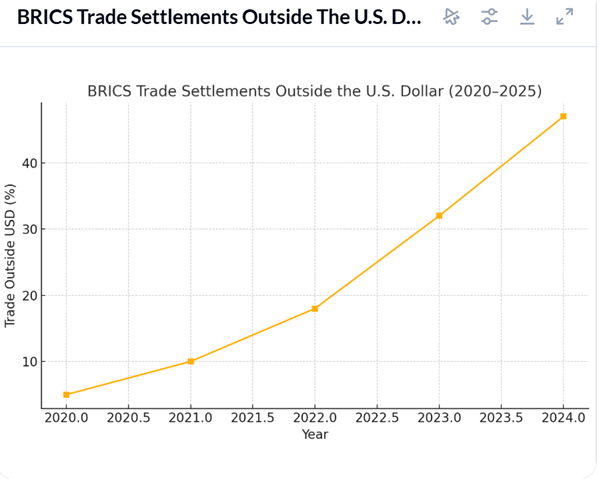
In the words of Russian President Vladimir Putin at the 2024 BRICS Summit:
“The dollar is being used as a weapon. We really see that this is so.”
The Dollar’s Rapid Weakening: A Dangerous Trend
Compounding the geopolitical shifts, internal factors within the U.S. are exacerbating the dollar’s fragility.
Inflation, massive federal debt, and volatile trade policies have eroded global confidence.
The U.S. Dollar Index — once a testament to the dollar’s unassailable strength — has fallen nearly 8% year-to-date, an unusually sharp drop compared to historical norms.
Graph: U.S. Dollar Index (DXY) – 5-Year Performance
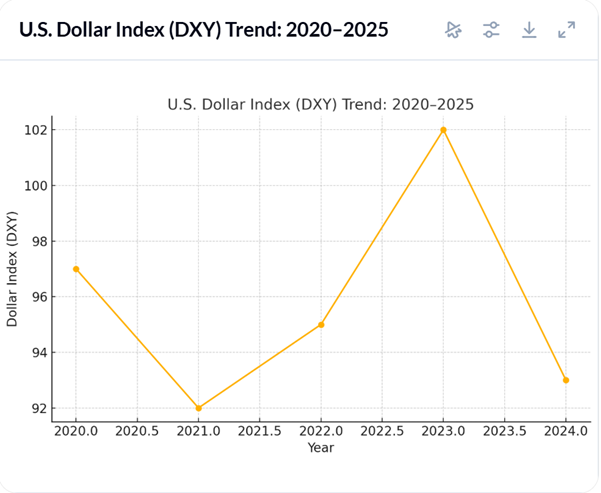
Source: TradingView, April 2025
The dollar’s sharp decline is eerily similar to what we witnessed during the 2008 financial collapse, when the Federal Reserve first resorted to Quantitative Easing to inject liquidity into a wounded economy.
Today, however, there’s an added twist: the threats are both external (de-dollarization) and internal (political instability and runaway debt).
Is There a Viable Alternative?
For now, no single currency seems poised to fully dethrone the dollar.
- The euro has stumbled under political and financial strains.
- China’s yuan remains shackled by capital controls.
- Gold and Bitcoin, while attractive as hedges, face significant hurdles to becoming practical mediums of exchange.
Thus, while de-dollarization is real and rapidly progressing, we are likely headed toward a multipolar currency world — where the U.S. dollar shares influence rather than dominates entirely.
Still, the trend is clear: the dollar’s days of singular dominance are numbered.
And for investors, businesses, and policymakers, the time to adapt is now.
Final Thought
De-dollarisation is not a speculative theory anymore — it’s unfolding right before our eyes.
Whether it leads to a global financial reset or a more diversified, resilient system depends largely on how the U.S. responds.
Ignoring the warning signs would be, quite frankly, un précipice dangereux — a dangerous cliff.
Written by Dyron Bush, CPA — 29-Year Accounting & Tax Expert, Board Member, and Industry Thought Leader.